Braces vs. Aligners: What the Long-Term Data Actually Shows
Clear aligners have reshaped orthodontic practice over the past two decades. Patient demand is high, the technology keeps improving, and the marketing has been relentless. But the clinical evidence comparing long-term outcomes with traditional braces has been slower to develop than the hype. A 2024 retrospective study published in the Journal of Pharmacy and Bioallied Sciences offers a direct comparison across four dimensions that actually matter: treatment duration, malocclusion correction, patient satisfaction, and long-term stability.
The Study
Design and Population
Researchers conducted a retrospective analysis of patients treated at a tertiary care center between 2020 and 2022. The study included patients aged 12 to 18 with mild to severe malocclusions treated with either conventional braces or Invisalign. Outcome measures included treatment duration, degree of malocclusion correction, and long-term stability, with statistical significance set at P less than 0.05.
Key Findings
Treatment Duration
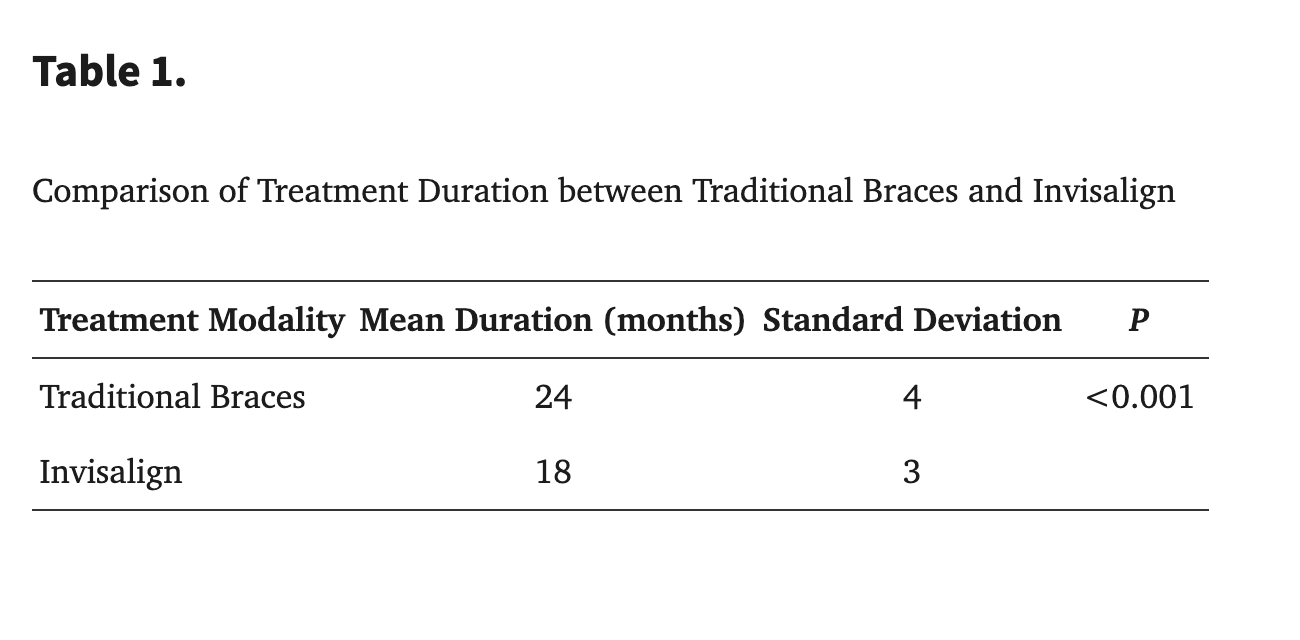
One of the cleaner findings in this study is the difference in treatment time. Invisalign patients completed treatment in a mean of 18 months compared to 24 months for conventional braces, a statistically significant difference at P less than 0.001. A six-month reduction in active treatment time is not trivial, particularly for adolescent patients balancing school, sports, and social life.
Malocclusion Correction and Stability
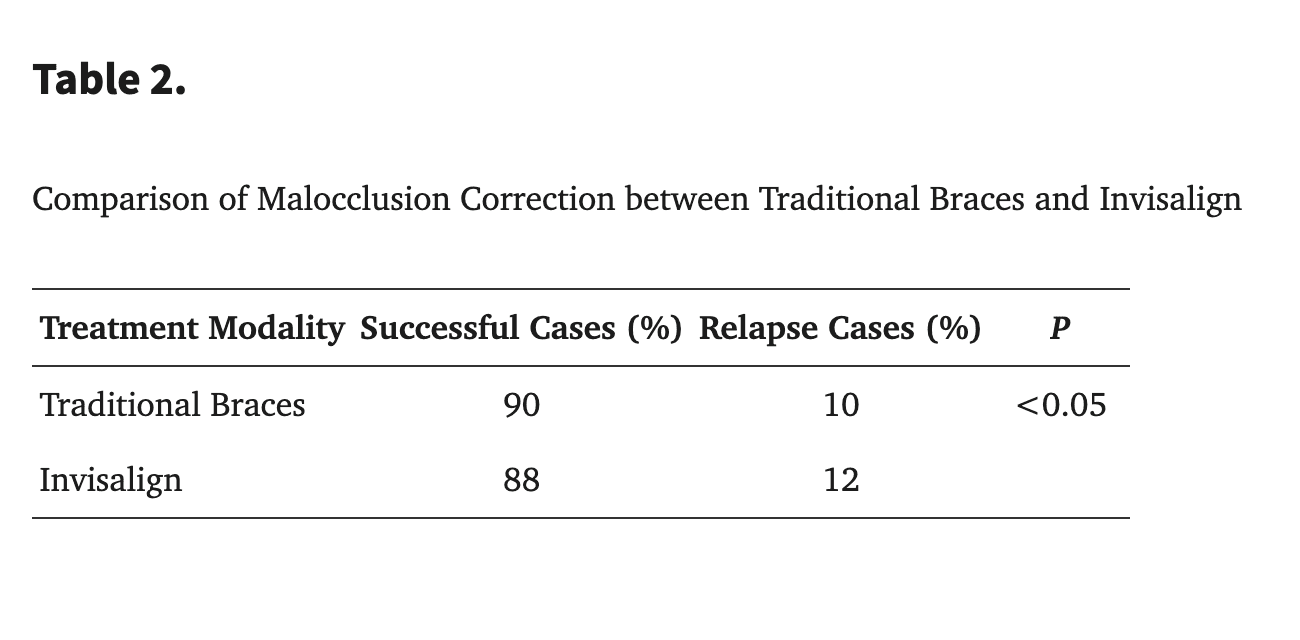
Both systems performed well where it counts most. Conventional braces achieved successful correction in 90% of cases and Invisalign in 88%, a difference that was not statistically significant. The relapse picture is where things get more nuanced. The Invisalign group showed a slightly higher relapse rate of 12% compared to 10% for braces, again not statistically significant, but consistent with a broader pattern in the literature suggesting that fixed appliances may offer marginally better long-term stability for certain tooth movements.
The authors attribute this to the mechanics involved. Sequential aligner adjustments may not restrict tooth movement or resist relapse forces as effectively as brackets and wires, particularly for significant rotations and extrusions.
Patient Satisfaction
Invisalign's removability and near-invisible appearance contributed meaningfully to patient comfort and compliance throughout treatment. The absence of metal brackets reduces oral irritation, and the ability to remove the appliance for meals and oral hygiene has real quality-of-life implications, especially for teenagers. Patient satisfaction is not a soft metric in orthodontics. Compliance drives outcomes, and a more comfortable appliance tends to get worn.
What This Means Clinically
Choosing The Right System
The data here reinforces what experienced clinicians already know. Both systems correct malocclusion effectively in the right cases. The meaningful differences are in treatment time, stability risk, and patient experience rather than in overall success rates.
Aligners have a clear advantage in treatment duration and comfort. Braces retain an edge in complex cases where precise root control, significant rotations, or extrusion is involved. The slightly elevated relapse trend in the aligner group, even if not statistically significant in this study, is consistent enough across the broader literature to warrant honest conversation with patients before starting treatment.
A Note on Limitations
The retrospective design limits causal inference, and the sample was drawn from a single tertiary care center. The authors also note that patient compliance with aligner wear was not directly measured, which is a meaningful variable in any aligner outcome study. Prospective randomized trials with larger samples and longer follow-up periods would give these findings more weight.
The Bottom Line
Neither modality is universally better. The choice comes down to the individual patient, their case complexity, their compliance profile, and what they value in a treatment experience. What this study makes clear is that the gap between braces and aligners in terms of clinical outcomes is smaller than the marketing on either side suggests, and that a thoughtful case selection conversation is more valuable than a default toward one system or the other.
Source
Aref S, Ravuri P, Kubavat AK, et al. Comparative Analysis of Braces and Aligners: Long-Term Orthodontic Outcomes. J Pharm Bioallied Sci. 2024;16(Suppl 3):S2385–S2387. Read the full paper →