LightForce 3D-Printed Brackets: The Technology and the Clinical Data
Custom bracket systems have long promised shorter treatment times and better outcomes. LightForce, the first fully 3D-printed bracket system, has taken that promise further than any predecessor. A 2023 retrospective study published in the Journal of Clinical Orthodontics puts clinical numbers behind those claims, and they are worth paying attention to.
The Technology
What Makes LightForce Different
Introduced in 2019, LightForce produces polycrystalline alumina brackets designed and printed individually for each tooth based on a digital treatment setup. Every bracket has a custom base contoured to that tooth's specific morphology and a slot prescription optimized for the planned movement. Conventional manufacturing cannot replicate this level of individualization.
The Digital Workflow
Treatment planning runs through LightForce's proprietary software, LightPlan, which generates a digital setup of the final dentition before a single bracket is printed. Indirect bonding trays are fabricated to match, transferring brackets from tray to tooth with positional accuracy that chairside bonding cannot consistently achieve.
The Rebond System
An underappreciated feature of the system is the custom rebond tray included with every case. When a bracket breaks mid-treatment, the tray allows precise reattachment to the exact planned position without relying on manual technique. Trays are pre-segmented by tooth, labeled with palmer notation, and functional at any stage of treatment regardless of surrounding bracket positions. Practically speaking, rebonding becomes delegatable to trained staff without sacrificing accuracy.
The Clinical Data
The Study
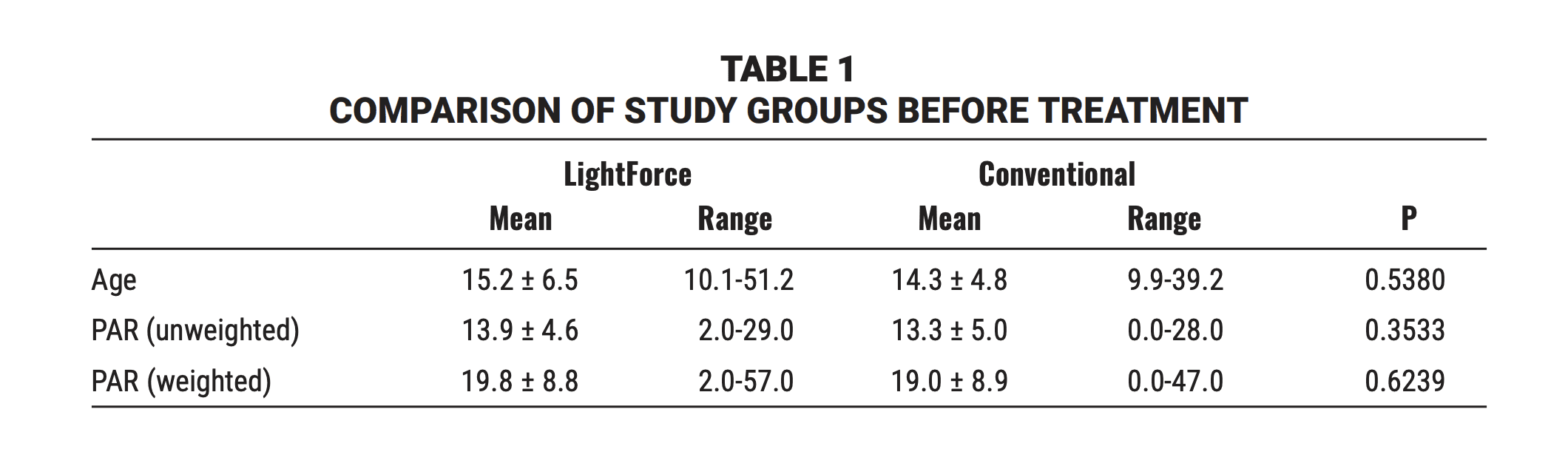
Waldman and colleagues conducted a retrospective analysis comparing 103 consecutively completed LightForce cases against 74 conventional bracket cases from a single private practice. Both groups were matched for age, initial case severity by PAR index, extraction rate, and Angle classification.
Treatment Time
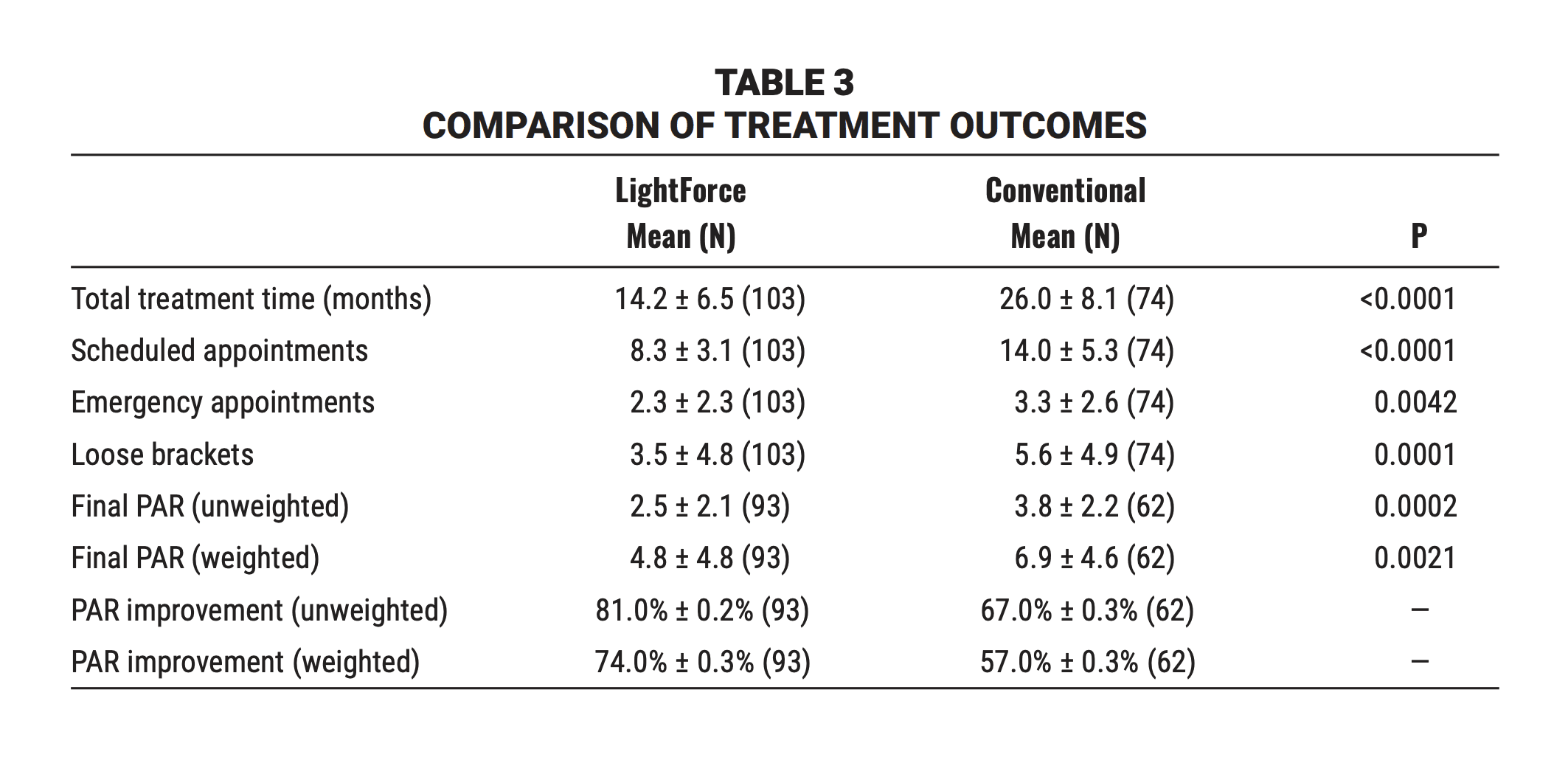
The headline number is a 45% reduction in treatment time. LightForce cases averaged 14.2 months compared to 26.0 months for conventional brackets, a difference that was highly statistically significant. The 26-month conventional average aligns with what prior literature consistently reports, which makes the comparison credible rather than inflated.
Appointments and Bracket Failures
The efficiency gains go beyond treatment time. LightForce cases required an average of 8.3 scheduled appointments versus 14.0 for conventional brackets, roughly six fewer visits per patient. Emergency appointments averaged 2.3 versus 3.3, and loose brackets averaged 3.5 versus 5.6. Six fewer scheduled visits per patient adds up quickly across a full caseload.
Clinical Outcomes
Results were measured using the PAR index, where lower scores indicate better occlusion. LightForce cases showed a mean PAR improvement of 81% unweighted and 74% weighted, compared to 67% and 57% respectively for conventional brackets. Final weighted PAR scores landed below 5 for LightForce and below 7 for conventional brackets, both within the range considered nearly ideal or acceptable occlusion.
LightForce finished cases not just faster, but to a measurably higher standard.
A Note on Conflicts of Interest
This study was supported by LightForce Orthodontics, and two of the four authors are company shareholders. That is worth acknowledging. The retrospective single-practice design also limits how broadly these results can be generalized. Independent multi-center replication would go a long way toward confirming what this study suggests.
What This Means
For Practice
A 45% reduction in treatment time with improved PAR outcomes is not incremental. If these results hold across practice settings, it changes how orthodontists think about case capacity, scheduling, and practice economics in a meaningful way.
The Upgrade Advantage
One of the more interesting aspects of 3D-printed brackets is how quickly the technology can improve. Unlike conventional manufacturing where design changes take months or years, LightForce can design, test, and implement bracket updates within weeks. The loose bracket data from this study shows this in real time. Cases created before mid-2020 averaged 5 to 6 loose brackets, while cases after July 2020 averaged 1 to 2. The system got meaningfully better while the study was still running.
For a field where material science moves slowly, that iteration speed is genuinely new territory.
Source
Waldman A, Garvan CS, Yang J, Wheeler TT. Clinical Efficiency of LightForce 3D-Printed Custom Brackets. J Clin Orthod. 2023;57(5):274-282. Read the full paper →